


AI customer support for events is no longer a nice-to-have—it is the only realistic way to stop support teams from drowning in repetitive questions while still improving NPS. Your support team can deal with complexity. That has never been the problem. But what wears them down is the constant stream of identical questions that circle in from every direction. Email. WhatsApp. Social media. Helpdesks. Hallway interruptions. Booth-side escalations. Ahhh, it’s all too much even to list down.
Every time someone asks, “Where do I pick up my badge?”, your team’s attention shifts away from the moments that actually shape customer experience… the warm welcome.. thoughtful interactions, and the rescue when something genuinely goes wrong.
Support becomes a game of whack-a-mole, not a relationship builder.
And that is where the real cost sits, in all the experience moments your team never gets to create because they are too busy repeating information people should have found easily.
AI walks in (with lots of swag) here to give your teams their time and purpose back.
What’s broken, and why it matters more than teams admit
The biggest misconception about support is that it is a staffing problem. If only we had more people during busy weeks, everything would feel manageable. But the truth is sharper than that.
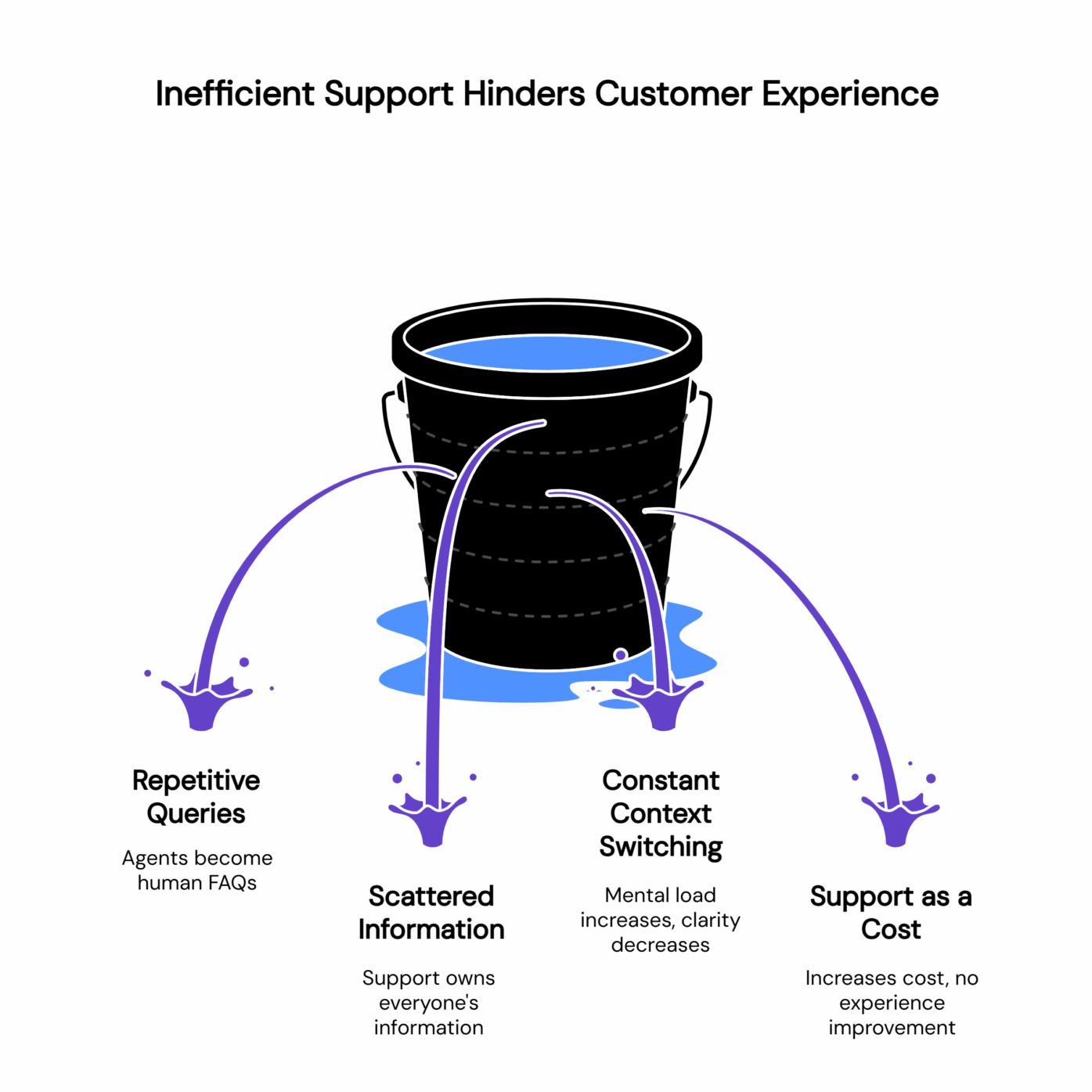
Most support work is not complex; it is repetitive. A lot of it happens because information is scattered, not because the question is difficult. And almost all of it is predictable.
Support feels heavy because:
- People ask the same questions over and over again
Badge pickup. Agenda timing. Venue locations. Booth dimensions. Speaker AV rules. The same questions surface hundreds of times simply because the answers are buried inside PDFs, long email threads, or internal sheets that attendees will never see. - Teams spend more time hunting for information than solving problems
Every answer requires jumping between tools. The act of finding information becomes harder than sharing it. - Burnout does not show up as frustration. It shows up as missed opportunities
When teams are stuck in reactive mode, they cannot build the relationships that influence NPS, reputation, sponsorship renewals, and return attendance.
That is why AI support agents matter. Not because they replace people, but because they create the breathing room required for actual hospitality. Humans get to be human again.
A real story from the field: How Terrapinn shifted from reactive support to experience-driven support
Terrapinn runs over 90 global events every year across energy, mobility, infrastructure, finance, and healthcare. Their operations teams are seasoned. Their events are large and respected. And yet they found themselves facing the same wall every year.
Attendees could not find essential information. Exhibitors kept asking the same logistical questions. Speakers sent frantic emails hours before their sessions. All of this was happening while the answers existed. They were simply impossible to find quickly.
Terrapinn wanted to change that through a different approach entirely.
They began with one experiment:
Train a Knowledge Agent on the full content of a single event. Give it access to schedules, manuals, exhibitor guidelines, and internal docs. Hand control of the setup to the operations team through a simple dashboard.
The idea was not to automate support. The idea was to free people from the noise so they could focus on real conversations.
The shift was immediate.
Attendees stopped waiting for replies, while exhibitors received booth-specific answers within seconds. Speakers found exactly what they needed without asking three different people.
Within a week, Terrapinn launched ten customised agents across multiple event sites. The process was repeatable, consistent, and steady enough to scale across their portfolio.
And the numbers told their own story:
- More than 4,000 attendee questions answered instantly.
- A 99 percent accuracy rate.
- Higher engagement with agendas and speaker bios.
- £3,000 saved in operational time per event.
- Teams finally had time for VIPs and high-value interactions.
This is the part that matters.
It’s important to note that AI did not replace Terrapinn’s people; it gave them the space to show up where they were needed most.
What started as a small pilot now runs across more than 50 events because the value was not in automation. The value was in restoring calm, clarity, and human connection.
If you want a deeper look at how the team scaled this across 50 events, you can download the full case study here.
Why support becomes an experience driver when AI handles the repetition
Once AI agents take over repetitive questions, something interesting happens.
Support no longer sits outside the experience, but becomes part of it.
- Attendees feel taken care of.
- Exhibitors feel guided.
- Speakers feel supported.
- Vendors feel informed.
And your support team stops operating in survival mode. They move from answering questions to anticipating needs. That shift creates a ripple effect across revenue, retention and loyalty.
Here is what changes behind the scenes:
- Response time drops to seconds, not hours.
People remember speed, especially when they are onsite and stressed. - Teams experience less burnout and more purpose.
They finally get to do the work they are proud of. - Brand consistency improves dramatically.
The tone never slips and the answers never contradict each other. - Global events feel genuinely accessible.
Language, region and time zone are no longer blockers. - Marketing and product gain real insight into audience behaviour.
Support becomes a source of audience intelligence, not just a cost line.
This is the heart of the story. AI support agents do not simply reduce workload. They upgrade the entire experience.
Where AI agents fit into your event and publishing workflows
Bridged’s Knowledge Agent creates a single truth source for your event or media operation. Instead of storing information across ten files and five tools, everything becomes connected and searchable.
The Knowledge Agent also delivers that knowledge across the channels your audience already uses. Chat, email, WhatsApp, onsite kiosks, and portals. It responds in your brand’s tone, adheres to the guidelines you set, and uses graceful fallback responses when something falls outside its scope.
It feels personal without requiring human intervention. It feels reliable even during peak traffic. And most importantly, it scales without breaking your team.
Let’s look at how this plays out in practice.
What this looks like for real people at your event
- For attendees
They get clear badge pickup details, session information that matches their pass type and quick access to updated schedules. No more scrolling through emails or guessing which link is correct. - For exhibitors
Booth rules, power requirements, shipping guidelines, and invoice details appear instantly. Say goodbye to last-minute panic at 11 pm. - For speakers
Green room details, AV instructions and bio updates become effortless. They start their sessions calmer and better supported. - For your operations team
The constant stream of repetitive messages slows down… they get time to handle the situations that genuinely require human judgment. And they can finally be present for VIPs, sponsors, and escalations that influence revenue.
In a nutshell
Support teams should not spend their days repeating the same information, and attendees should not feel lost in the hours leading up to an event. And, last but not least, exhibitors should not have to chase people for details that already exist.
AI support agents turn scattered information into a transparent, reliable, always-on experience layer.
The result is support that is faster, calmer, more personal, and easier to scale. It becomes a driver of NPS and loyalty instead of a cost that grows every season.
If you want to see how your own documents behave inside an AI agent, we can set up a quick test run using your existing FAQs and content. It is a simple way to understand how this could work for your team in real workflows.
FAQs
- How does AI improve customer support for publishers and event teams?
AI provides instant, accurate answers, adapts responses to each user group and reduces repetitive workload for human teams. - Will AI replace human support teams?
No. AI handles predictable questions while humans focus on nuanced and relationship-driven interactions. - Can AI support agents handle last-minute changes?
Yes. Updates made in your source files update the AI’s responses immediately. - Does AI reduce support costs?
Yes. Organisations typically see significant savings because automation removes the need for repeated manual intervention. - Can AI improve NPS?
Yes. Faster, clearer and more consistent support directly lifts satisfaction scores and loyalty. - How are AI support agents different from chatbots?
Chatbots follow scripts. AI support agents understand your knowledge base and respond like trained team members.